Showing posts with label book. Show all posts

Friday, 24 July 2015

Flower Pressing

For as long as I can remember I have pressed flowers. 
As a child I loved preserving blooms by squashing them between the pages of books, and then later on I bought a little wooden press decorated with birds and blossom. The papery, two-dimensional results lasted for years. I used them to decorate cards and make pictures for relatives. After university when I worked in an office I made pressed flower bookmarks and cards and sold them to my colleagues. For Christmas cards I sprayed pressed leaves with metallic paints and used ferns as stencils. I seem to remember they were quite popular.
I've carried on pressing flowers on and off over the years, and this week decided it was time again to do some more, so I wandered around the garden gathering blooms. It's important to do this on a dry day so that they're completely dry and fully open.


There were some late aquilegias and tiny wild strawberry leaves,


frothy green alchemilla, lilac scabious and dark, dark geranium phaeum,


inky-purple clematis and umbelliferous (love that word) bronze fennel.


I started off by making a layer of cardboard and then one of paper. The cardboard must be thick and not corrugated (as this leaves imprinted lines), and the paper must be white and quite absorbent. Blotting paper is perfect. I arranged these tiny pink 'Fairy' roses upside-down with their stalks cut off, allowing plenty of room between each flower.


After another layer of paper, cardboard and then paper again I placed the clematis blooms.


More paper, cardboard and paper ... you get the idea. This time the aquilegias on their sides and the geraniums face up. I find that the flowers' shapes will dictate how you place them. The secret is not to have really thick, fleshy plant material as it won't dry easily during the pressing process.


Next layer, scabious heads. The blooms need to be handled gently to avoid damaging them.


Now tiny, neat strawberry leaves.


Alchemilla snipped into little florets.


Umbrellas of fennel, ready to splay out into mini explosions. 


Some more closed, placed side-on for a different perspective.


Finally the remaining layers of paper and cardboard piled up on top.


Next came the wooden top with the screws upwards in each corner.


And now time to press down very hard to get the wing nuts on and tightened. If, like me, you've really filled up the press you many wonder if they'll fit, but they will (I have been known to stand on it while I tighten it!). After a couple of days I tighten again, as the flowers will have had time to dry out and lose some bulk. It was now time to leave it for at least two weeks.


Here's a large press my dad made for me years ago when I was making cards to sell. I stencilled it at the time with bluebells.


This book is very inspiring, suggesting lots of imaginative pressed flower projects.


It's full of useful tips and lots of ideas like this plant diary, a page of pressed flowers and leaves for each month of the year.


Some of the designs are quite complicated, like this sumptuous herbal.


And others are more simple, like this pretty little card.


And others are unusual. I have pressed seaweed in the past, and it keeps its shape and colour well.


I like the fact that flower-pressing is a bit of a gamble: you never know how the finished product will turn out. I shall let you know in a couple of weeks!

Saturday, 17 May 2014

Wild Garlic

When we went to the bluebell woods a couple of weeks ago, we stopped off along the way to pick wild garlic first. We've been doing this for a few years now, and it's become one of the seasonal markers in our year.
From mid-April into May the unmistakeably pungent aroma greets the nostrils of anyone who passes through the woods or along roadsides where it grows. We followed the path and went over the stile, and we were there, surrounded by garlic.


Like bluebells, it grows in deciduous woodland and carpets the ground with little white flowers when in bloom. Its other names are ransoms, bear's garlic, jack-by-the-hedge and stinking jenny, and it is a member of the allium family which includes onions, leeks, garlic and chives. 


Unlike garlic, it's the leaves which are eaten, and not the bulbs, but care must be taken when picking not to take too many leaves from one plant. You must also ensure that you have identified the correct plant (your nose will tell you!) For anyone interested in foraging, this book is invaluable, and gives rules on picking.


The flowers are pretty little globes of white stars, although apparently you should aim to pick before too many of the flowers have opened, as the taste is better. I smelt the flowers, and they have a curious perfume of honey mixed with garlic which was not unpleasant!

There were lots of other signs of spring that day - buds were opening on the trees.


Tiny yellow celandines were dotted here and there on the ground.


Red campion was also in bloom, such a pretty wild flower. It always seems to link spring into summer for me, coming as it does, as the bluebells are past their prime.


Its hairy stems are particularly attractive, and so soft to the touch. I can remember picking them as a child and putting them in jam jars with butter cups and cow-parsley.


 The buttercups were there too, a gorgeous saucer of egg-yolk yellow.


Bright and sunny, with reflective waxy petals to catch the light.


So much to see in one quick trip to the woods! All around us the carpet of green and white stretched under the trees and we worked quickly, collecting a couple of bags of leaves to take home.


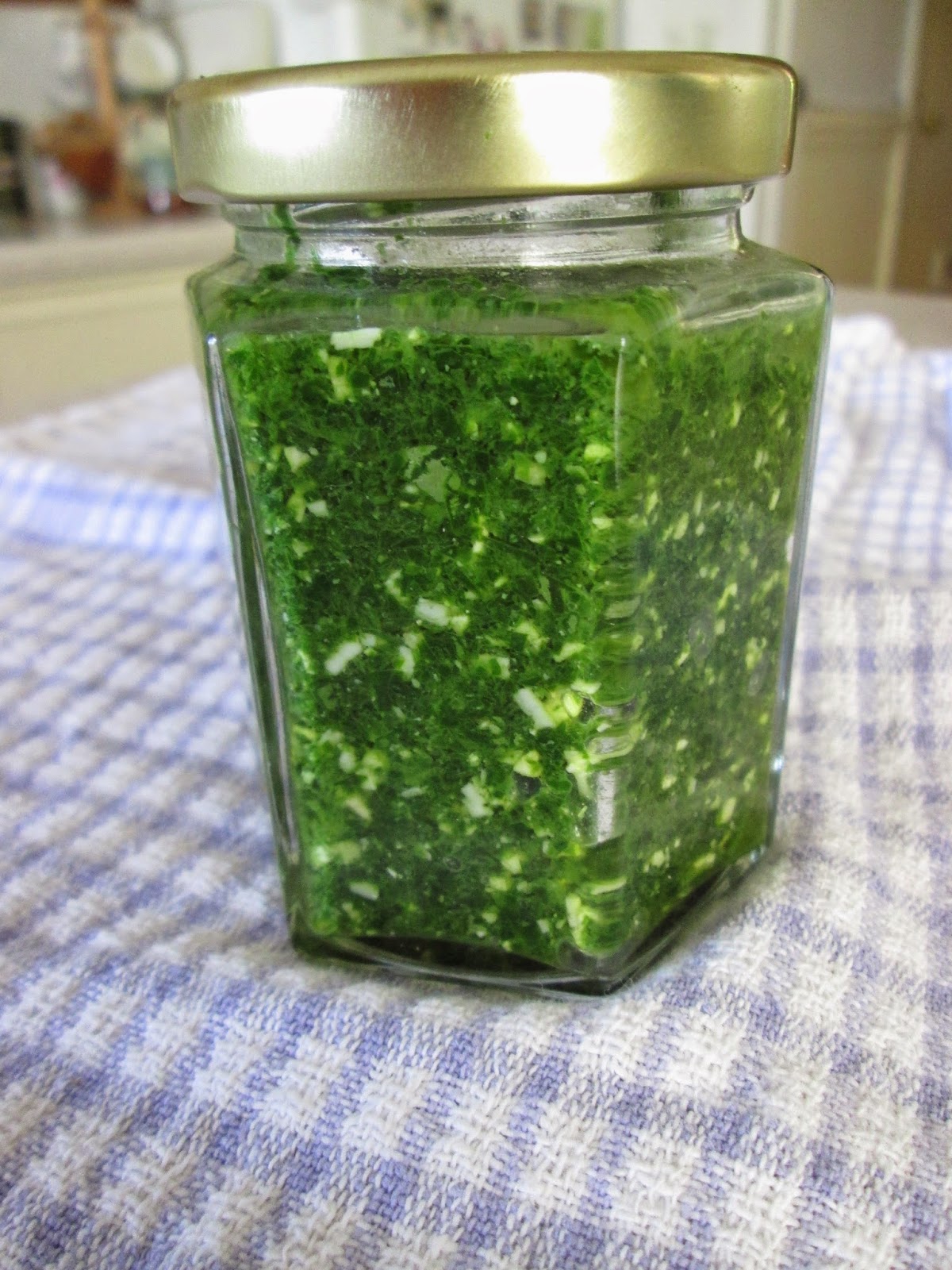
Once home, I washed and roughly chopped the leaves, and then whizzed them up in a little processor to chop them very finely. I then whizzed up some pine nuts, grated some parmesan and mixed it all together with lots of olive oil to make pesto.


The smell is absolutely heavenly, and so appetising, I can almost smell it when I look at this picture! I put some into jars, and the rest I froze in little tubs and ice-cube trays, so that we can enjoy it into the rest of the year.


I've got a small patch in the garden which my son planted for me a year ago, and will use a few leaves to make some cheese and garlic scones, as well as putting it in a salad. It goes especially well with tomatoes and mozzarella, and can be used in the same way as spinach in many recipes, wilting down very quickly when added at the end of cooking. We like to eat it with pasta and courgettes, and when we do it reminds us of our trip to the woods.


Wednesday, 7 May 2014

Bluebell Woods

This weekend was a long bank holiday weekend, and we felt in need of a visit to the woods. In particular, bluebell woods. They are usually at their best a little later in the month, but we had already glimpsed many in grass verges and in gaps in trees from the car when we've been out and about. I knew there was no time to spare, if we were to catch them at their peak, and so off we went to some woods a couple of miles away from where we live. The woods are in the grounds of a big old estate, and a road bisects them. We parked the car and after a few minutes came to a large patch of them.


That blue haze is unmistakeable, and Sara Maitland refers to their 'strange smoky shimmer' in her book Gossip from the Forest (a brilliant read if you're a fan of woodlands, forests or fairytales).


They are such a quintessential spring flower. The UK has around 50% of the world's bluebells, as we have just the right damp climate and plenty of ancient deciduous woodland. In Scotland the little campanulas that English people call harebells are called bluebells.


English native bluebells, or hyacinthoides non-scripta, have that unmistakeable droop to them and are an intensely violet shade of blue. They are sadly in decline because they hybridise with the Spanish bluebells which most of us have in our gardens. You can read about it here.


I got down to their level to smell them, and oh, the perfume! It's so delicate, and always puts me in mind of the scene in my favourite novel 'I Capture the Castle' in which Cassandra and her sister Rose visit a department store in London and find a bluebell scent for sale. They are poor and yearn for it, but later on when Cassandra is given it as a present she realises that it can't compare with the smell of the real flowers. I wonder if that's why the scent of bluebells isn't more widespread in modern perfumes.

Bluebells frequently grow under beech trees, and these woods were no exception. Beech leaves are so fresh and green this time of year and I love to see the sunlight through them


The trees around us were very tall and straight and the atmosphere so still, calm and quiet.


On the woodland floor there were many tree stumps attractively covered in moss and ivy.


There were several wild flowers in bloom too. The strangest one is arum. It has many other names such as cuckoo-pint, lords-and-ladies, jack-in-the-pulpit, wake robin, friar's cowl and devils-and-angels to name a few. Some of its names are rather rude, and a good deal of folklore is attached to it.


I also saw herb robert, which is a member of the geranium family, and has a smell like coriander.


There were also some lovely wild violets, growing amongst the ferns.


I'm glad we got out to see the bluebells at their best. They really are so uplifting. Hope you get to see some too this May x